Thursday, August 27, 2015

Population Health Mapper Wins at ESRI User Conference!


HealthLandscape is recognized as one of the top three GIS applications at the ESRI 2015 User Application Fair.

HealthLandscape is privileged to regularly attend and WIN at the User Application Fair for the fifth year in a row. Our very own Jene Grandmont presented the Health Landscape Population Health Mapper.  The Population Health Mapper enables users to select metrics from the seven categories and use a slider bar to set thresholds. By default, thresholds are set at values that represent national benchmarks.  The tool will highlight those counties that are outside of the national benchmark, or will incrementally shade or remove counties depending on how the user modifies the thresholds for selected indicators.  A huge thank you to everyone who participated and allowed us to continue on our winning streak! 

2015-08-26_1542.png

See our account from the ESRI User Conference 2015 here: http://healthlandscape.blogspot.com/2015/08/report-from-esri-user-conference-2015.html 

Claire Meehan
User Engagement Specialist
HealthLandscape


Learn more about the Population Health Mapper Tuesday September 9th at 11:00AM!


Learn more about HealthLandscape with our online Webinars and Training

Thursday, August 20, 2015

21st Century Healthcare Demands Robust Health IT Workforce

The healthcare industry is facing a problem: shortages of health IT workers. This problem could loom even greater as changes in ICD codes roll-out this year. To combat this problem, the right tools and data can be used to identify some of the key drivers of these shortages and where these problems are likely to play out. We here at HealthLandscape can effectively address some of these issues by digging into data with new interactive and visually effective tools such as HealthLandscape Storymap that explores some of the characteristics of health IT workers and how they differ across the United States.

This first map (below) shows employment rates of Medical Records and Health Information Technicians by state. On average, states with higher employment rates (or lower unemployment rates) will have greater labor shortages. From quick glance at the map, we can see that clusters of high employment of Health IT workers appear in the Northern Rockies (Wyoming, Montana, North Dakota, and South Dakota), Northern New England (Vermont, New Hampshire, and Maine) and Hawaii. Conversely, employment rates are lowest in the south stretching from South Carolina to Florida. The rate of employment equals the number of employed workers divided by the total labor force (the number of employed workers plus the number of unemployed workers).
Figure. Employment Rates of Medical Records and Health Information Technicians by state
There tends to be an inverse relationship between employment rates and wages. This map shows median wages of full-time (30 hours or more per week) Medical Records and Health Information Technicians. On average, areas with higher employment rates of Medical Records and Health Information Technicians tend to have lower median wages. A way to potentially offset labor shortages for health IT workers is to increase wages where employment rates are high.
 Figure. Median wage of full-time Medical Records and Health Information Technicians by state
This map shows the average age of Medical Records and Health Information Technicians by state. On average, areas with higher average ages tend to have higher employment rates. This is striking because with an aging Health IT workforce in areas with labor shortages, labor shortages in these areas will become an even greater issue in the future.

Figure. Average age of Medical Records and Health Information Technicians by state.

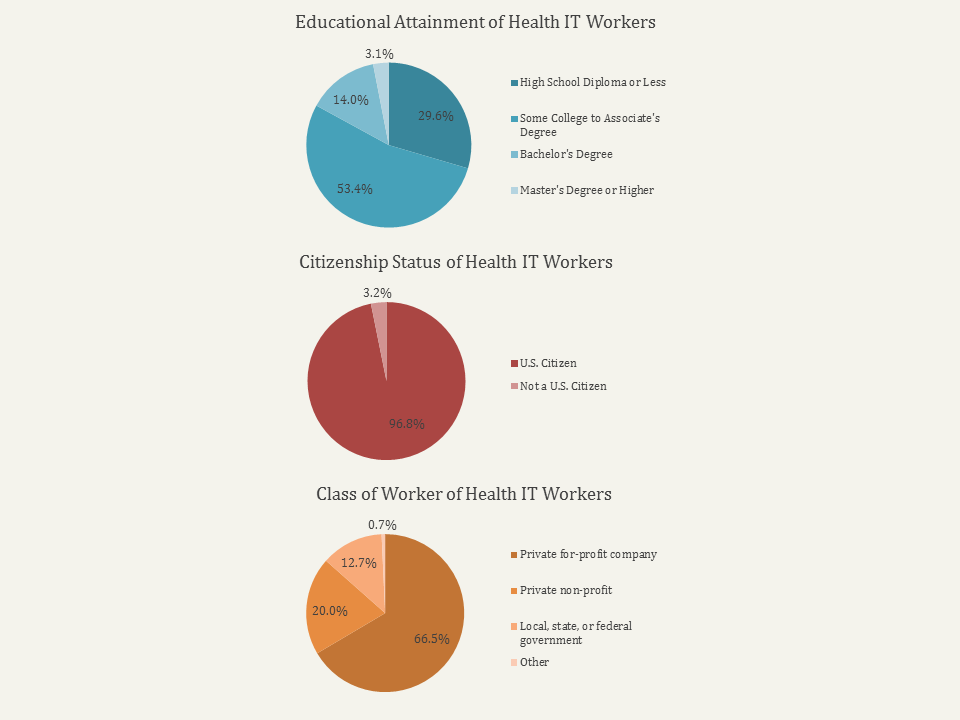
Finally, Health IT workers show some striking characteristics:
  • Nationally, the majority of health IT workers have less than a bachelor's degree, typically with either a high school diploma or some college education.
  • Nearly 97% of health IT workers are U.S. citizens.
  • Most health IT workers (66.5%) work for a private for-profit company followed by private non-profit companies (20%).

Paul Maliszewski 
GIS Strategist
HealthLandscape

To access the Healthcare Workforce Storymap, see 

Want to Learn More?

Learn more about HealthLandscape with our online Webinars and Training
In-depth instruction on using HealthLandscape tools and additions to our ever-growing data library


Tuesday, August 11, 2015

Report From Esri User Conference 2015


The Esri International User Conference takes place each summer in San Diego, California. The HealthLandscape application is built on the esri ArcGIS platform, so we regularly attend the conference to discuss our work and to stay current in esri technology and trends. It’s a great opportunity to mingle with other data geeks, learn some new tips and tricks, and see what kinds of new and exciting projects our peers are working on. As always, the agenda was packed full of interesting sessions, educational opportunities, and user group meetings.


This year, I had the opportunity to present two moderated session papers on behalf of the team. Both presentations discussed the importance of looking at patients in the context of their home communities, but from two very different perspectives; public health research and individual practitioners.

Accelerating Data Value Across a National CHC Network introduced the new HealthLandscape Geocode API, which allows organizations to append community and social determinants data to patient-level data: giving them a unique way to enrich their investigations of patient-centered outcomes. Appending these types of data will allow for the exploration of clinical and disease-oriented service areas, hotspots, and coldspots. The Community Context of Health Center Patients focused on how we can use population-based big data and geospatial technologies to understand the social and environmental influences on the health of a physician’s patient panel through the idea of Community Vital Signs - as patient vital signs provide a biometric snapshot of an individual’s health status, community vital signs provide an environmental health perspective. Taken together, we can improve the care that patients are receiving. Both of these projects will be featured as detailed blog posts in the coming weeks.

In addition to our paper presentations, HealthLandscape was once again recognized as one of the top three GIS applications in the User Conference Applications Fair. The HealthLandscape Population Health Mapper builds upon the idea of “Place Matters,” a concept discussed in a recent blog. Users can select county-level metrics from seven categories identified by the CDC as recommended Health Outcomes and Health Determinants, using a slider bar to set thresholds and easily identify counties that perform poorly compared to the national average. We've highlighted this tool on the blog and will be hosting a “Population Health Mapper” webinar on Wednesday, August 19th. Click here to register, or contact us by email for more information.


I always enjoy the time that I spend at the Esri User Conference and I never fail to return home with new collaboration opportunities, new skills, and new ideas. I’m thrilled to take home another HealthLandscape award this year, too.


Jené Grandmont
Senior Manager, Application Development and Data Services
HealthLandscape

Tuesday, August 4, 2015

How Place Matters to Health


How does Place Matter to the health of the public and the health of an individual?

I have a catch-phrase answer I use that says simply “Because Everything Happens Somewhere.”  This deceptively simplistic response actually hides a fair amount of complexity.  Where a person lives, where they spend many hours working during a year, and how they travel to and from their home and work all greatly impact their health and well-being.  Let’s look at a few examples.

Environmental Hazards

 Air quality can impact individual and population health.  Fine particles from automobiles, power plants, wood burning, industrial processes, and diesel powered vehicles such as buses and trucks may adversely impact air quality.  Research suggests deleterious effects including asthma, bronchitis, acute and chronic respiratory symptoms such as shortness of breath and painful breathing, and premature deaths (EPA).

HealthLandscape Community HealthView Data for Particulate Matter

Another example is a remnant of the Cold War and a byproduct of the Nuclear Arms race.  The U.S. has hundreds of factories and research facilities with potentially hazardous nuclear waste, the true health impact of which will not be known for many years.  You can learn more about these "Waste Lands" in this project of the Wall Street Journal.

Access to Healthcare Providers

Not everyone has equal access to health care providers, including primary care physicians, specialists, hospitals, specialty services, and pharmacies.  The HealthLandscape Healthcare Workforce Mapper can be used to learn where there are shortages of physician and non-physician providers.


Family Medicine Population to Provider Ratio, by County

Thinking Beyond the Individual

Place and the environmental can also have indirect, long-term effects on the health of people through the cascading impact on the food chain.  You may remember recent stories from the town of  Ribeauville in France, where beekeepers found their hives were producing blue and green and various colored honey.  It was discovered that the bees had begun feeding on waste from a local candy factory that was producing treats dyed in colors of bright red, blue, green, and yellow.  These dyes had been collected by the bees and deposited in the honey.  This colorful episode was not considered an immediate health concern -- though the honey was an economic loss because of the unnatural coloring.  However, it provides stark evidence of the impact environmental conditions miles away may have on the food chain and subsequently the health of people who consume that food.

Learning to Think Spatially

OK, so, how do I orient my thinking to recognize the possibilities of space and place on health?  Learning to think spatially is an ongoing process, but there are a few concepts that will help you start down the path to lifetime learning.

As a start, you should always consider What (Location), Where (Patterns among multiple Locations), and When (Temporal Relations -- how those Location(s) and Patterns changes over time).
  • What is the population you are studying?  Are you interested in individual congestive heart failure patients, failing students, older homes likely to have used lead-based paints?
  • Where are they in relation to one another and related locations?  How close are patients to clinics or hospitals, what is the travel (time or distance) to the nearest primary care provider, is there suitable public transportation in areas where households are less likely to have cars or areas of high traffic congestion?
  • How have these conditions changed over time?  What is the impact of the opening (or closing) of a primary care office, the loss of adequate bus transportation, the loss of specialized equipment or treatment services in a section of the city?
Learning to THINK spatially is an ongoing process, and we haven’t even talked about how to use Geographic Information Systems, or GIS, to help wrangle some of these concepts and ideas into manageable analysis and meaningful visualizations.  Take an opportunity to visit us at HealthLandscape (and sign up for one of our webinars) to see how GIS can help you understand how Place Matters to the health of your community.

Mark Carrozza
Director
HealthLandscape

Wednesday, July 15, 2015

Hospital Value-Based Purchasing (VBP) Explorer

The Affordable Care Act has recently funded several innovative programs aimed at improving Medicare quality while reducing costs.  A key part of these efforts is to link Medicare payment to the quality of care rather than the quantity, with the goal of moving away from fee-for-service payment models.

One such innovative program funded by the Affordable Care Act is the Hospital Value-Based Purchasing (VBP) program. The Hospital VBP program adjusts hospital payments for Medicare based on performance across four domains of quality: clinical processes of care, patient experience of care, outcomes (includes mortality rates and patient safety indicators), and efficiency (Medicare spending per beneficiary).  While evaluation of initial data indicates that the program has been successful, with the majority of hospitals showing improved care and outcomes for Medicare beneficiaries (see http://blog.cms.gov/2014/12/18/cms-releases-data-on-quality-to-help-patients-choose-providers/), it is unclear how hospital performance varies across states or regions.

Map view showing rollover windows displaying scores for clinical processes of care, patient experience of care, outcomes, efficiency, spending, and total performance


HealthLandscape created the Hospital Value-Based Performance (VBP) Explorer as an interactive mapping tool that allows users to visualize the geographic variation of the four quality domain scores, spending scores, and total performance score for hospitals in California, Florida, Illinois, Michigan, North Carolina, New Jersey, and New York.  Hospitals are displayed as points colored red (lowest quartile of hospitals), yellow (second and third quartile of hospitals), or green (fourth quartile of hospitals), allowing users to quickly compare performance across hospitals.  Users can also filter the data displayed on the map based on whether hospitals received a penalty for having a low total performance score or excess readmissions. In addition, users can use the Stats tool to perform statistical analyses to explore relationships between hospital performance scores and population health indicators for the county in which the hospital is located.

Stats tool showing relationship between total performance score by hospital and county-level percent renter occupied housing for the county in which a hospital is located

You can use the Hospital Value-Based Performance (VBP) Explorer at:
http://www.healthlandscape.org/HVBPExplorer/map.cfm


To learn more about the Population Health Mapper, join one of regular webinars at

Wednesday, June 24, 2015

Place matters to personal and population health.

Place matters to personal and population health.  The social determinants of health have begun to shape public health and policy interventions and neighborhood socioeconomic and demographic characteristics play significant roles in influencing health outcomes. 

The continued realization that place matters has led to the emergence of the field of population health, which includes health determinants, health outcomes, and links between the two.  The Robert Graham Center, the policy arm of the American Academy of Family Physicians, recently hosted a forum focused on population health, with experts from New Mexico and North Carolina offering their perspectives on how to address the social determinants of health.  Dr. Arthur Kaufman, the vice chancellor for community health at the University of New Mexico Health Sciences in Albuquerque, discussed how practices in New Mexico’s university system are beginning to take note of the importance of social determinants that are often ignored, such as low education or poor living conditions.  Kaufman also mentioned the critical role of community health workers in helping physicians reach and assist community members dealing with financial or social issues.  Dr. L. Allen Dobson, Jr., president and CEO of Community Care of North Carolina (CCNC), described how CCNC is linking their data with real-time pharmaceutical data to create risk scores for patients.  Dobson noted how these data have been essential for reducing hospital admissions and readmissions by allowing physicians to reach patients before patients reach the hospital.  See future Primary Care Forum topics.

Issues remain, however, as to what determinants and outcomes are most important to measure, as well as the availability of these data at relevant geographies. In response to this, the Centers for Disease Control and Prevention (CDC) created a resource guide of the most frequently recommended health outcomes and determinants, the Community Health Assessment for Population Health Improvement. The guide breaks down the data into two domains, Health Outcomes and Health Determinants, and then separates dozens of indicators into several categories, including Mortality, Morbidity, Health Care, Health Behaviors, Demographics, Social Environment, and Physical Activity.


Using this guide as a framework, HealthLandscape created the Population Health Mapper which includes the majority of the Health Outcome and Health Determinant Metrics identified in the report at the county level.

The Population Health Mapper allows users to select metrics from the seven categories and use a slider bar to set thresholds. By default, thresholds are set at values that represent national benchmarks.  The tool will highlight those counties that are outside of the national benchmark, or will incrementally shade or remove counties depending on how the user modifies the thresholds for selected indicators.  Darker gradations of color will indicate which counties are outside of the established thresholds for multiple indicators.  Users can also view a histogram that shows the number of counties outside of thresholds by the number of indicators, allowing users to quickly filter by the number of indicators that are outside of the established thresholds.

You can use the Population Health Mapper at:


To learn more about the Population Health Mapper, join one of regular webinars at

Tuesday, May 19, 2015

HealthLandscape's Accountable Care Organization (ACO) Explorer

As part of the Affordable Care Act, new models of health care delivery have been developed with the objective to improve the quality of care while reducing costs.  Accountable Care Organizations (ACOs), which are made up of groups of doctors, hospitals, and other health care providers that coordinate care for Medicare beneficiaries, are being touted as potential solutions for the inefficiency and fragmentation of the U.S. healthcare system. One of the early Medicare ACO programs, the Medicare Shared Savings Program (MSSP), has shown promising results. ACOs in the MSSP have experienced improvements in the majority of quality measures while generating cost savings (see http://blog.cms.gov/2014/12/22/acos-moving-ahead/).

In order to compare how ACO performance varies geographically, HealthLandscape developed the ACO Quality Explorer, which is a spatial visualization tool for data from the 211 ACOs taking part in the MSSP.  The ACO Explorer allows users to visualize 33 quality measures organized into five domains: patient/caregiver experience, care coordination/patient safety, preventive health, at-risk population diabetes, and at-risk population heart-related measures. Each ACO is given a site score based on the percentage of quality measure benchmarks set by the Centers for Medicare and Medicaid that the ACO has met. ACOs are displayed as points on the map colored green (4 or more domains with all measures at or above thresholds), yellow (2 or 3 domains with all measures at or above thresholds), or red (less than 2 domains with all measures at or above thresholds), allowing users to quickly compare different ACOs across a geographic area.  When users click on a specific site, they can view exploding rollover windows which contain data about the quality measures included in each of the five domains. In addition, users can use the Stats tool in the ACO Quality Explorer to perform statistical analyses to explore the relationship between ACO quality metrics for an ACO and population health indicators for the county in which an ACO is located.


To access the ACO Explorer, see http://www.healthlandscape.org/ACOExplorer/map.cfm


Want to Learn More?


Learn more about HealthLandscape with our online Webinars and Training
In-depth instruction on using HealthLandscape tools and additions to our ever-growing data library